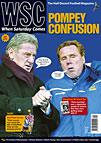
Dear WSC
In response to a letter published about the term “mullered” (Letters, WSC 228) and the origins of the word, at the risk of turning WSC into an episode of Balderdash & Piffle, I always felt it appropriate for the term to be linked to fabled West Germany forward Gerd Müller and the team of the early 1970s. Despite being too young to recall “Der Bomber” in his heyday, checking out old videos of him in action (hardly ever leaving the penalty area in a fashion Gary Lineker could only dream of) and a check of his goalscoring feats – 68 goals in only 62 international matches – it seems to tally with my favoured definition of “mullered”, to be comprehensively beaten in a surprising and unimaginative manner. The only other time I have heard of the term “mullered” is in relation to drinking too much alcohol which, sadly, may be linked to the end of Gerd’s career.
Jonathan Paxton, via email
If you’re feeling fleeced by UK ticket prices and fancy a change of scenery, there are plenty of top continental clubs eager to attract your support and speaking your language, Ian Plenderleith finds
For many home football fans, British connoisseurs of the continental game have always been regarded as a pretentious breed who tend to look down their noses at the hoof and hump of island football. But with the help of budget air fares and many of the major European clubs still offering tickets at accessible prices (in contrast to the hype- and hyper-inflated Premier League), it can almost be cheaper to indulge in a trip to La Liga or Serie A than it is to spend an afternoon at St James’ Park. Or even Blundell Park.
A new generation of football magazines has appeared in Europe of late, breaking the monopoly of established, establishment titles. The first of an occasional series looks at the subversion and humour attracting readers in Germany. Philipp Koster reports
The magazine (literally 11 friends) began in April 2000 with a print run of 2,500. There was no marketing department or organised distribution, just two Arminia Bielefeld fans with the desire to produce magazines. Before that we’d had a small fanzine called Um halb vier war die Welt noch in Ordnung (At half three the world was still OK) – and noticed that supporters liked a certain type of writing: ironic and critical of the growing commercialisation of football. We naturally thought that these fans needed a national voice.
A new generation of football magazines has appeared in Europe of late, breaking the monopoly of established, establishment titles. The first of an occasional series looks at the subversion and humour attracting readers in France. Neil McCarthy reports
Publishing its 30th monthly edition in January 2006, S0 Foot is becoming firmly established as France’s main alternative football magazine with a print run of 80,000 and an estimated readership of more than 200,000. It’s not a mean feat, considering that French football is already largely covered by three mammoths: the daily L’Equipe, its bi-weekly stable mate, France Football, and the monthly Onze Mondial. L’Equipe and France Football both celebrate their 60th birthdays this year and Onze Mondial, France’s equivalent of Shoot!, its 30th.
The decline of three o’clock Saturday football has claimed another victim, to Peter McParlin’s regret
On Saturday December 17, 2005, 110 years of Tyneside tradition came to an end when the last edition of The Pink, the Saturday evening results paper published by the Newcastle Evening Chronicle since 1895, rolled off the presses. The paper has become obsolete in an age when mobile phones can deliver instant goal alerts from hundreds of miles away. Who needs a late edition for the results when that little piece of gadgetry in your pocket can even replay the goals on its mini LCD screen? But to those of us of a certain age, new technology can never replace what The Pink, and its like elsewhere in the country, used to add to Saturday nights.