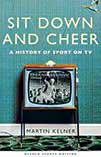
 A history of sport on TV
by Martin Kelner
John Wisden & Co, £18.99
Reviewed by David Harrison
From WSC 311 January 2013
Buy this book
Having worked in broadcasting, I’m painfully aware that those on the inside can be guilty of attaching far too much importance to the social significance of their output. For the viewer, television remains essentially what you do when you get home and remove your shoes. But with average viewing holding steady at around four hours a day, there are so many opinions we’ve all accumulated – consciously or not. Consequently, donning our football hats, every one of us has a view on the relative merits of commentators, presenters, pundits and the like.
Martin Kelner has tapped into the great national pastimes of sport and TV with this extensively researched work. It covers the developing relationship between the two, from the early days – characterised primarily by suspicion and resentment – through to today when everything has changed, apart from the suspicion and resentment.
The opening chapters are fairly dull, accurately reflecting TV coverage of sport for most of the last century. Things don’t really get going, in real life or the book, until the FA Cup’s “Matthews Final” in 1953 when the first rights payment was made for coverage of a live sporting event. Kelner observes that this represented the first occurrence of footballers overtaking their cricketing counterparts in terms of public awareness. So many pioneering figures, on both sides of the camera, have helped drive televised sport to the intrusive position it holds today and Kelner is happy to acknowledge and credit, generally without attempting to compare – apart from the BBC incarnation of Des, his absolute favourite.
Age will determine where the reader’s affections and admirations lie, but they’re all here – from a football perspective commentators such as Captain Henry Blythe Thornhill “Teddy” Wakelam, who delivered Britain’s first live sports broadcasts in 1927, through massive figures like Raymond Glendenning, Peter Dimmock, Kenneth Wolstenholme, David Coleman, Brian Moore and beyond. Pundits, effectively a 1970 World Cup innovation, are acknowledged and discussed, as are the off-screen visionaries who made it happen – men like the heroic Dimmock, Angus Mackay, Paul Fox, Bryan Cowgill, John Bromley and many others. And then there’s Jimmy Hill, a man who could justifiably claim a place in all three groups.
The book is characterised by Kelner’s gags; many dismal, for which he consistently and wisely blames others, but some very funny. The factual stories also contribute greatly. In the weeks before the consummate Coleman took over as presenter of Grandstand, I particularly liked the account of Dimmock’s own attempts to read results from the teleprinter. Not a football man, Dimmock was confronted with “Cltc 3 Ptk Th 1” which, in the absence of any assistance through his earpiece, he delivered as “Celtic 3 Purr Thaaa 1”. Kelner wears his lack of actual match attendance as a badge of honour and the device works well. If this book appears under your Christmas tree, you may well finish it before the turkey sandwiches appear.
Buy this book
 by Richard Purden
 A new anthology of Victorian football writing
 How the English Premier League came to dominate the world