Sorry, your browser is out of date. The content on this site will not work properly as a result.
Upgrade your browser for a faster, better, and safer web experience.

The Archive

Articles from When Saturday Comes. All 27 years of WSC are in the process of being added. This may take a while.


Focus group

Roger Titford analyses how the role of the crowd is changing, thanks to television's demands

My abiding memory of the 2002 World Cup is the rhythm, uniformity, noise and collective willpower of the South Korean crowd. In France 1998 the way England fans dominated some stadiums with flags and song was impressive but the South Koreans took it to another level – and reached the semi-finals. South Africa 2010 has been a very good tournament with lots of smiling faces. But it’s been two steps backwards in undermining the role of genuine, traditional support which is about being united and getting behind your team.

Read more…

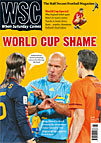
World Cup 2010 TV diary – Knockout stages

The climax to the 2010 World Cup adds a new name to the trophy, as seen on TV

Round of 16 ~ June 26
South Korea 1 Uruguay 2
There are acres of empty seats for a match played in a downpour. Last week Peter Drury compared chilly conditions to a match at Notts County; we now discover Jon Champion’s benchmark for a rainy day at football: “Weather you’d expect at Port Vale.” Some Uruguayan fans are wearing Óscar Tabárez facemasks. Park Chu-Young has the first chance, his free-kick bouncing off the post with Fernando Muslera beaten. But the Uruguayans might have been three up at the break – Lee Jung-Soo gets away with a handball and Luis Suárez is wrongly flagged offside when clean through. Their one goal is a calamity for Korea, the prone Jung Sung-Ryong swiping ineptly at Diego Forlán’s cross as it flies right across the area to Suárez. Muslera is equally at fault for the equaliser, failing to connect with a defensive header that goes straight up in the air – “Look up the definition of no-man’s land, he’s there,” says Craig Burley – and it is finished off by the “Bolton Wanderers man”, Lee Chung-Young. Uruguay’s deserved winner is superbly curled in by Suárez, “the man they call El Pistolero”, after the Koreans fail to clear a corner. That 49-goal season for Ajax, the most repeated stat we’ve heard at the World Cup, gets another airing while Suárez appears to bounce off a photographer’s head en route to a group hug with the substitutes. Such celebrations are treated as a felony in English football but no one has been booked for them at the World Cup. Korea get a final chance but “Middlesbrough fans will not be surprised” as Lee Dong-Gook’s weak shot is held up on the muddy pitch and cleared.X

Read more…
Musical chairs

Henrik Manninen says goodbye to an old favourite and explains a possible embarrassment of riches in Stockholm stadiums

“Sweden’s Rasunda Stadium is one of just two venues in the world – California’s Rose Bowl being the other – that has hosted the final of both the FIFA World Cup and the FIFA Women’s World Cup. This football-specific stadium, located in the district of Solna some four miles north-west of Stockholm city centre, is famed for putting spectators right on top of the action, and it still generates a fantastic atmosphere for the ever-competitive Sweden national team.”

Read more…

Friendly fires

James Eastham attends a star-studded charity match and feels that a similar situation would look very different in England

May 25, 5pm. Real Madrid president Florentino Pérez’s private jet touches down on the tarmac at Marck aerodrome, 183 miles north of Paris. Out steps a smiling Zinedine Zidane. He strides over to greet 200 or so supporters eagerly waiting for an autograph or photo.

Read more…

Target practice

A football club set up for asylum seekers in Vienna has found itself pressurised by the Austrian state. Paul Joyce explains

“FC Sans Papiers is a fight against racism and discrimination using modern and elegant means – sport,” explains its president Dr Di-Tutu Bukasa, who founded the side in 2002. Inspired by the French political movement of the same name, the Viennese team offers asylum seekers who lack an Austrian residence permit the chance to play regular lower-league football.

Read more…

Copyright © 1986 - 2026 When Saturday Comes LTD All Rights Reserved Website Design and Build C2