{youtube}wTf1sOl2IDg{/youtube}
Author Archive
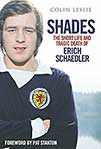 The short life and tragic death of Erich Schaedler
by Colin Leslie
Black & White, £17.99
Reviewed by Archie MacGregor
From WSC 328 June 2014
Erich Schaedler was the son of a former German POW who became an integral part of the swashbuckling, but ultimately fragile, Hibernian side of the early 1970s and was capped once by Scotland – as fate would have it against West Germany. To this day his death in December 1985 aged just 36 is surrounded by unresolved and unsettling questions. This biography sets out to find an answer to why his body was found in his car with a single shotgun wound to the head in countryside near his hometown in the Scottish Borders. Though a police investigation concluded there were “no suspicious circumstances” and it is generally regarded as having been suicide, some, including Schaedler’s immediate family, could not accept that he would have taken his own life.
Colin Leslie, the author of this overdue and exhaustively researched appreciation, is in as good a position as any to try to get to some sort of closure on the tragedy, being both a lifelong Hibs fan and currently sports editor of the Scotsman newspaper. Yet even after scores of interviews with former colleagues, friends, acquaintances and Erich’s older brother John he is forced to conclude that a definitive explanation for what happened remains
“elusive”.
Though one of Leslie’s aims may be left unfulfilled, his book also provides a telling reminder of what a genuinely fine footballer the unheralded Schaedler was. As a player with a ferocious dedication to his fitness regime as well as interests in physiotherapy and coaching that were well ahead of their time in the Scottish game, there is testimony after testimony of how, through hard work, he developed from a raw talent into an international class full-back. The “Turnbull’s Tornadoes” Hibs side that he served so well really ought to have registered more major honours than a solitary League Cup final victory in 1972, but they had a gnawing propensity to fall away in their league campaigns and suffered painful defeats to Celtic, by scores of 6-1 and 6-3, in another couple of cup finals. In a later spell with Dundee Schaedler helped the club notch up a couple of promotions and again made it to a League Cup final.
Across the chapters the shadow of what was to ultimately transpire hangs heavily however. Leslie rightly gives space to reflect on the issue of mental health which football, like other areas in society, still struggles to address in a truly open and grown up way. Many of the interviewees mention that “Shades” could be quiet, withdrawn or “deep” but hardly any saw him as someone who might need help. Although attitudes and awareness may be changing it is a dreadful irony one of his team-mates at Dundee, Ian Redford, also recently committed suicide, as covered in WSC 325. Redford’s own reflections on his former colleague’s sometimes introspective moods – “There were a few demons I think, although I have no idea where they came from” – lend a final poignancy to the recurring theme of this thoughtful book.
 Ledley King: My autobiography
by Ledley King
and Mat Snow
Quercus, £18.99
Reviewed by Alan Fisher
From WSC 328 June 2014
The title of the opening chapter of Ledley King’s autobiography sums it up in two little words: “What If?” He was the perfect contemporary centre-half, with pace, strength, total application and his trademark timing in the tackle as he eased the ball away from onrushing forwards. It was a talent that should have brought him worldwide fame. Instead he spent half his career on the treatment table.
His fortitude in pain and loyalty to the only club he has ever played for has earned him the enduring respect of Spurs fans. An unending saga of breakdown and comeback meant his hopes were rebuilt then crushed as often as his knee, yet King does not show a trace of self-pity; despite agony, disappointment and upheaval at his club, he was grateful for the chance to play.
For virtually half his career King did not train. When his knee was rebuilt, he remodelled his running style. One report suggested that toward the end, his knee was so bad he couldn’t have a garden kickabout with his young son yet come matchday he was often a match for the very best.
Co-author, journalist and Spurs fan Mat Snow utilises a conversational style which gives the book a sense of authenticity, especially in the early passages about King’s upbringing on an east London council estate by a single mother and surrounded by a supportive network of family friends. King has some interesting reflections on the fine margins between success and failure at this level, concluding that attitude and family stability are more significant than ability.
It seems to be out of character to be critical of those around him so expect few revelations. Nonetheless, King sheds some light on the footballing culture differences between Fabio Capello and his squad and confirms years of managerial turmoil at Tottenham, with Glenn Hoddle distant and unable to communicate while first-team coaches Martin Jol and Gus Poyet actively undermined their managers, Jacques Santini and Juande Ramos respectively.
While there’s plenty of interest to Spurs supporters, King played during a largely undistinguished period in the history of club and country so other potential readers may be deterred by a book where the highlight is a League Cup final win and a world tour of physiotherapists. Gradually the dreary routine of daily treatment catches up on body and mind. He plays down the two nightclub altercations that thrust him uncharacteristically into the headlines but there’s no doubt they were linked to the loss of what had mattered most to him since he was a boy – the realisation that he can’t play on and the end of his camaraderie with team-mates. If King has regrets, he hides them well. It’s left to the reader to speculate about those “what ifs?” on his behalf.