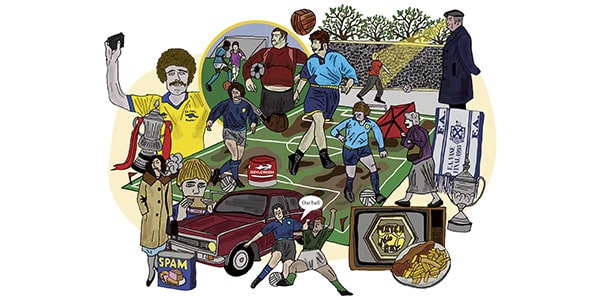
Illustration by Steve Beerling
The winning entry in our 2025 writers’ competition reflects on a father and son’s football relationship. Entries are now open for the 2026 competition
By Robert Dear
The boy thwacked the ball against the flint wall. It ballooned back, smothered in churchyard and rotting leaves. His father had followed him and was watching from behind the dark yew. “You should be in Sunday school!” The boy ran his fastest. But his father, the town centre-half, was faster. He dragged the sobbing boy back to their damp cottage and leathered him scarlet.
Dad was nine when that happened to him in 1946. It didn’t put him off football, but it did put him off churches. He went on to get much faster and to play many seasons for Arlesey Town in the South Midlands League. He told me about his father and his own footballing days while we were watching 1970s Match of the Day and eating fish and chips – something we did most Saturday nights.
He played inside-right. Like briar pipes and Brylcreem, inside-rights are now almost forgotten. Dad’s job was linking up with the centre-forward and the right-winger. They rotated positions during the match to bamboozle the other towns’ back lines. Local pitches were “like a turnip field” and the towns and villages loathed each other “more than Tom hates Jerry”. The old-style leather ball sponged up muddy water and after ten minutes was, he said, like heading an ice block. One “grumpy old woman” of Stotfold, local Spurs to Arlesey’s Arsenal, would stand on the touchline and lunge at Dad with her umbrella as he sprinted past.
Dad played local football into the late 1960s. But all the time he played, his father (the churchyard spy) never bothered to go and watch him. I know that hurt Dad. He never told me, but Mum did after he died.
I remember sitting pitchside aged four hiding from driving rain in our Vauxhall Victor and gripping my Mother’s Pride spam sandwich. The windows were wound shut and Mum was smoking like a burning tyre (which everyone’s mum did in 1967). Suddenly Mum yelled: “There’s your Dad!” Two rain-soaked players were hacking at a ball stuck between them. It cannoned off their clashing shins and rolled towards our car. They both threw up their hands and yelled: “Our ball!” I had no idea what that meant at the time. Of course it was their ball, they were playing with it.
In 1972, my seven-year-old’s enthusiasm for Airfix soldiers meant I wanted a football team that had something to do with guns. Arsenal pyjamas duly arrived, probably still glistening with 1971 Double-winning glamour, and that was it. Apart, that is, from an unfortunate flirtation with Wolves in 1975 when I was led astray by their beautiful golden kit and black wolf badge.
Later, when Dad was a rotund woolly-jumpered 46, we played “Wembley Pairs” – two-a-side knockout, one goalmouth – against my teenage mates. He still had a heavy shot and good control, even with a left knee that was mostly minced cartilage. Sometimes Dad and I would win and celebrate like it was the World Cup. Even the silliest and smallest football games can bring you closer.
I watched the 1979 Cup final with Dad for emotional support. With Arsenal 2-0 up, he made me a semi-celebratory half-time tea. “They’ll probably win now,” he said. “Don’t say that!” Even 15-year-olds know the football gods are always listening. All seemed well at first, with most of the second half looking pie-easy from our golden velour settee. But even back then, this was still Manchester United. “McIIroy’s through!” yelped John Motson. My stomach fell out. United had equalised in the 88th minute.
We heard the United fans at No 14 bellowing like caged minotaurs. Dad and I stared at the telly in Antarctic silence. But immediately, at first unbelieving, we saw Liam Brady glide through and slide the ball to Graham Rix who crossed… to Alan Sunderland, stretching far-post to hook in Arsenal’s winner. Sunderland charged into frenetic, crazy whooping close-up with his military moustache and bouncing perm. Our settee was bombarded with a trampolining teenager, showers of tea and (at the other end) a quietly smiling Dad. No 14’s United minotaurs went very quiet.
But our closest football moment was watching Arlesey beat Diss Town 1-0 during their extraordinary run to win the FA Vase in 1995. I could see Dad was proud of his old team and pleased I was there to watch them with him. His local football club was inextricably part of him, deeply entwined with his parents (for good and bad), his friends and who he was. Dad never supported a big club. For him his football team was something local and intimate, part of the place he was born and had his roots, not a consumer choice. After Arlesey, there could be no other.
When Dad was dying of cancer, football gave us conversations where we could relax together and try to forget about what was happening, however briefly. One Sunday afternoon, as he sat in bed bewildered and desolated by the disease, I told him there was a big match on at 4.30pm. “Great,” he whispered. “I might get up for that.” I smiled and squeezed his hand. We both knew he wouldn’t be getting up. But at the end of his life, football was a refuge for us and a language of love.
Entries are now open for the 2026 WSC writers’ competition
This article first appeared in WSC 456, September 2025. Subscribers get free access to the complete WSC digital archive
Want to see your writing published in WSC? Take a look at our pitching guide and get in touch

Tags: Writers' Competition