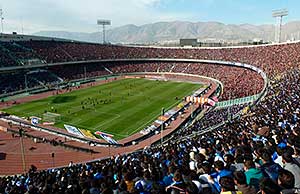
 The Azadi Stadium in Tehran is home to Iran’s national team as well as the country’s most successful club, Persepolis, and their city rivals Esteghlal. The Azadi was built for the Asian Games in 1974 and has a record attendance of over 128,000, which was set for a 1998 World Cup qualifier against Australia. The current capacity is lower at 91,623.
Author Archive
{youtube}JoW0lF9oXzc{/youtube}
{youtube}Dx2zjEIe0pA{/youtube}
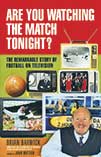 The remarkable story of football on television
by Brian Barwick
Andre Deutsch, £18.99
Reviewed by Roger Titford
From WSC 321 November 2013
There’s one memorable phrase in this book, describing the television pictures from the 1970 World Cup in Mexico as “blurred, almost like a watercolour painting caught in a rainstorm”. There are also a fair smattering of interesting or half-forgotten facts: only 12 matches were televised live at the 1966 World Cup finals, the term “route one” came from the show Quiz Ball, and there is a reminder that TV folk generally do not produce great works in print. Efforts by John Motson, Jeff Stelling and Barry Davies come to mind.
To give Brian Barwick his due, this is an intentionally lightweight account for the less well-informed and written in a matey journalese liberally splashed with exclamation marks. It is the complete opposite of a misery memoir – everyone has a wonderful time, are great friends and meet famous people. Andy Gray’s Sky career ends with an “alleged misdemeanour” and the ITV Digital fiasco of 2002 is glossed over in a single paragraph. The content is as uncontroversial and pro-establishment as a footballer’s autobiography of the 1950s. Those who would question the structure of the Champions League are dubbed “purists and romantics”. Such an approach is to be expected by a former chief executive of the FA and head of BBC and ITV Sport in a long and successful career which continues as a consultant.
Barwick’s story follows a fairly straightforward chronological path from the first TV pictures in 1936 to the present day and is certainly more colourful on the 20th century era in which he was personally involved. He reminds us of what happened with a mix of social history-lite and obvious landmark matches. But he ignores his unique opportunity to reveal the story of how it was done – how the techniques of football coverage have adapted, or not, to audience demands.
He does make a couple of points about how TV commentary has evolved into a conversation between commentator and pundit and how there now can be too many action replays for his taste, to which he regrettably adds the words “I digress”. Actually, this is potentially more interesting than a repetition of the value to Alex Ferguson of Mark Robins’s Cup-winner at Forest in 1990. And it is certainly more interesting than the semi-macho accounts of scraps between BBC and ITV staff when trying to get inconsequential post-match interviews as players come off the Wembley pitch.
Perhaps there is value in the anecdotes. Roy Kinnear gets mistaken for Joe Kinnear. Jimmy Hill gets to take sex symbol Raquel Welch to Chelsea. George Best nearly doesn’t turn up. After spending the morning at the British Grand Prix, Barwick flies by private plane to the World Cup final in Paris and gets locked in a stadium toilet while relieving himself of the champagne he drank on the way. My heart bleeds. Alas my sides do not ache. Maybe they are the kind of stories where you had to be there rather than just sitting at home watching TV.
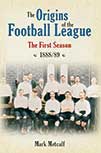 The first season 1888/89
by Mark Metcalf
Amberley, £14.99
Reviewed by Paul Brown
From WSC 321 November 2013
In 1888, during the early days of professional football, clubs began to look for a way to secure a regular income beyond that generated by occasional cup ties and friendly matches. It was Aston Villa director William McGregor who proposed the solution, suggesting that “the most prominent clubs in England combine to arrange home and away fixtures each season”. As the Football League celebrates its anniversary 125 year later, Mark Metcalf’s extensively researched book examines the inaugural season of the game’s oldest league competition.
The Origins Of The Football League opens with a brief but useful primer on the state of football in 1888. It was an evolving game in which there were no penalty kicks or goal nets, and goalkeepers could handle the ball anywhere within their own half. But growing interest and attendances allowed the League’s 12 founder members to flourish. Indeed, 11 of the 12 still play League football today – the exception is Accrington (not to be confused with Accrington Stanley), who folded in 1896.
The book traces the 1888-89 season via a series of match reports, many of which are taken from contemporary newspapers. These early reports have, as Metcalf puts it, “a certain symmetry to them”, typically detailing the weather and pitch conditions, while studiously recording who won the toss before presenting a fairly perfunctory account of the play. “The visiting right made an attack that was cleared by Bethell,” reads an opening-day report for Bolton Wanderers v Derby County, “and in two minutes from the start Kenny had scored a fine goal for the Wanderers. A protest for offside was raised in vain.” That Kenny Davenport goal was, the author reveals via some detective work involving kick-off times, the first League goal.
Without wishing to spoil the book’s ending, the story of the 1888-89 season is also the story of Preston North End’s “Invincibles”, who won the League without losing a game. “The feat North End have accomplished, gaining 18 victories and four draws [is] a record for which no comparison can fairly be found,” one reporter wrote. Preston also beat Wolves 3-0 in the FA Cup final to claim the first football “double”. That was hard lines for the fearsome Preston full-back Nick Ross, who missed the triumph by moving for a single season to Everton.
Ross is profiled in the book’s comprehensive gazetteer, alongside hundreds of other players ranging from the well known, such as Johnny “All Good” Goodall, who scored 21 goals in 21 games for Preston in that first season, to the virtually unknown, such as the mysterious W Mitchell, who played one game for Blackburn Rovers, scored two goals and was never heard of again.
The comprehensive nature of The Origins Of The Football League may be both a blessing and a curse. For the casual reader, a book that contains hundreds of consecutive match reports, many of which are relatively inconsequential, might not represent much of a page-turner. But as a book to dip into – and as a reference work – it’s a valuable and timely record of the birth of one of football’s most important institutions.