WSC Logo

rss

Sign up for the WSC Weekly Howl

A small portion of despair and enlightenment delivered to your inbox every Friday


First name
Surname
Email

newissue medrec 317

gplus50

chairman 170x140


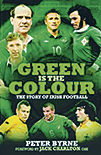
Green Is The Colour

305GreenistheColour The story of Irish football
by Peter Byrne & Matthew Murray
Carlton Books, £14.99
Reviewed by Ciaran McCauley
From WSC 305 July 2012

Buy this book


It is hardly surprising given the island's turbulent history, but football in Ireland has never been a simple matter. Just take the eligibility issue, which has dominated relations between football authorities north and south in the past few years. James McClean's selection for the Republic's Euro 2012 squad, and a few brainless morons issuing death threats on Twitter, made headline news once again and stirred up the usual hornets' nest.

The Irish who-can-play-for-who furore illustrates two key points. Firstly, relations between the Irish Football Association (IFA) and Football Association of Ireland (FAI) rarely appear anything other than frosty.

Secondly, what the hell happened for things to get this way? In a country where every other sport is happily played on an all-Ireland basis, why does football suffer the indignity of such tension?
Into this knowledge breach steps Peter Byrne's Green Is The Colour, perhaps the first authoritative overview of the history of the two associations.

Taking the origins of football in Ireland as its starting point, the book outlines the formation of the IFA in Belfast – the world's fourth oldest football association – and its running of the game in Ireland before the disgruntled Leinster Football Association broke away to form the FAI just days after the partition of Ireland in 1921.

Neatly illustrating the symmetry between Ireland's political strife and the football power struggle, Green Is The Colour goes on to outline nimbly decades of squabbling between the two associations over everything from who could pick what players (eligibility again) and even who had the right to call themselves Ireland in international games.

These early decades make up a large portion of the book, with Byrne's scrupulous research offering invaluable insight into the power plays at work between two associations fighting desperately for control of the game.

The writer clearly appreciates the difficulties in overseeing the growing sport in a country struck by sectarian divisions and never lets his academic eye for detail get in the way of a good anecdote – for instance, his eye-opening account of the Irish Free State taking on Germany in 1939, the Nazi state's final football match before the war.

If anything, the book is too ambitious. Despite being packed with information, it feels light in some areas and Byrne largely skips over the more well-known modern days. But he spends large chunks looking at the FAI's struggles, notably in taking on the fiercely nationalist Gaelic Athletic Association which was against "British" games. This is excellent material but it leaves this ostensible history of the game on both sides of the border with a distinct slant to the South.

Nonetheless, Green Is The Colour remains a fascinating account of how football related to one of the 20th century's most enduring local conflicts. A must-read for all Irish supporters and highly recommended for anyone with an interest in the tantalising contradictions of how football, the great unifier, has always been divided on the island.

Buy this book

On the subject...

Comment on 20-07-2012 14:30:53 by Diable Rouge #692917
You had the same difficulty with the TV series - the first two episodes were classic documentaries, detailing the early history of Irish football, but from the Charlton Era onwards, they tried to cram too much into two episodes, especially when the material was so familiar to modern audiences.
Comment on 20-07-2012 16:20:41 by Valentino Mazzola #692953
What happened for things to get this way? Does the author note the fact that, when the Troubles were at their worst, catholics and/or players from the 'nationalist' persuasion where happy to play for NI, giving the province some of their best ever players. Why has this changed? NI less 'Irish' than ROI? Uncomfortable with symbols? I want the anthem changed too. Union flags are now a minority at WP. The prospect of ROI getting to more tournaments? Maybe more so now (24 Euro teams), but how many more than NI really? They're still two poor sides.
Comment on 20-07-2012 21:30:36 by Diable Rouge #693034
Valentino Mazzola wrote:
What happened for things to get this way? Does the author note the fact that, when the Troubles were at their worst, catholics and/or players from the 'nationalist' persuasion where happy to play for NI, giving the province some of their best ever players. Why has this changed? NI less 'Irish' than ROI? Uncomfortable with symbols? I want the anthem changed too. Union flags are now a minority at WP. The prospect of ROI getting to more tournaments? Maybe more so now (24 Euro teams), but how many more than NI really? They're still two poor sides.


A combination of both the North's decline and looser citizenship rules after the GFA - also there was little incentive to join the Republic pre-86, when the Republic was little more than a soccer backwater, akin to Iceland or Lithuania now.
Comment on 20-07-2012 23:34:14 by Duncan Gardner #693059
"In a country where every other sport is happily played on an all-Ireland basis, why does football suffer the indignity of such tension?"

This is simply wrong. Consider those other sports:

Rugby Union: the supposedly all-Ireland side plays almost* all its matches in Dublin, and runs out only to the South's national anthem under only the South's national flag. Its one full international in NI in the last 50 years was treated by the IRFU as an away fixture. Happily all-Ireland my hole.

GAA: the Association has discriminated aganst the British and Unionist communities in Ireland for decades, barring large groups from membership, 'foreign' games from using facilities and continuing (in 2012)to commemorate convicted paramilitaries in its competitions, club names etc. Happily all-Ireland my hole.

Athletics, other Olympic sports etc.: although the South's Olympic bodies claim jurisdiction over all-Ireland (and are quite happy to enrol NI competitors when their own aren't good enough), in practice those competitors have a choice who they declare for. Indeed many have turned out for both the South in the Olympics and NI in Commonwealth Games etc. That doesn't stop Dublin's Olympic mafia throwing Hickey fits when their British equivalents sign up NI competitors. Fcuk em, happily all-Ireland pretty much my hole.

Loser citizenship rules since 1998? Not really. NI footballers were eligible for the South well before that, but tended not to play for a combination of reasons- the South were weaker, IFA pulled rank and it just wasn't a political issue.

The Irish Republic's citizenship rules have clearly got tigher recently, most obviously in 2004 when a referendum supported by 80% confirmed that birth on the island would no longer confirm it automatically.

Do better.
Comment on 20-07-2012 23:35:47 by Duncan Gardner #693060
Er, and it's two countries.
Comment on 21-07-2012 02:24:12 by Valentino Mazzola #693079
So basically he's talking about why two countries are having differences when throughout the article he's describing it as one anyway. Jeez, no wonder James McClean was having issues.
Comment on 21-07-2012 02:33:11 by Valentino Mazzola #693081
Btw, for such a substantial tome to be about the football island, it must be a metaphorical elephant in the room than the Republic side only managed qualification for anything in 1988. Or is it just me?
Comment on 22-07-2012 11:08:58 by The Awesome Berbaslug!!! #693279
there are two international teams on the island of ireland, because football is a real meaningful international sport, and as such doesn't ignore the existence of countries, unlike rugby which wishes we'd never left the Union, and GAA, which refuses to accept that it ever happened.
Comment on 22-07-2012 14:06:43 by AB2 #693315
AB2
Berbaslug, Northern Ireland isn't a country.
Comment on 22-07-2012 17:51:26 by Diable Rouge #693365
Duncan Gardner wrote:


GAA: the Association has discriminated aganst the British and Unionist communities in Ireland for decades, barring large groups from membership.


Well, when the B Specials and the RUC actively discriminated against Catholics since 1921, and the British Army effectively claimed squatters' rights in Crossmaglen, it's unsurprising Rule 21 was in force for so long. There was never any rule barring Unionists or Protestants per se from joining the GAA, but it's true they'd hardly have been comfortable with the prevailing ethos.
Comment on 22-07-2012 20:24:12 by Duncan Gardner #693402
@Bubblebath: Northern Ireland is a country for international football purposes just as the entire island is for international hockey, tiddly-winks or whatever. Of course you're right, neither entity is a sovereign state. Big deal, Queen Anne's dead.

@Diable: Whataboutery alert. I'm talking about GAA intimidation in 2012, not Operation Motorman or Wind shaking the bastard barley. The stick-beaters (as you know perfectly well) banned anyone with pretty much any connection to the British Police or Army: everyone from Colonel O'Grady down to the barrack cleaner. They cede to nobody in the cock-waving bigot stakes.

@Valentino: to be fair to the South, they made the quarters in Euro 64 (when it was a wholly knock-out tournament).

Assuming that Ciaran McAuley is neither a daydreaming Sinn Fein spokesman nor one of those simpletons who thinks merging a mediocre football team with one worse will make the new entity World-beating almost by definition, he's just using this 'review' for shit-stirring.
Comment on 25-07-2012 14:39:08 by RamonTheWolf #694392
Did you know that Diego Maradona played his first game for Argentina in May 1980 (against Ireland)?

It's unlikely that many people were aware of this, at least until they read this book.

If you see Diego, be sure to tell him. He probably still thinks he won his first cap in 1977.

Sadly, this is not the only inaccuracy in a disappointing book.
Comment on 26-07-2012 15:02:34 by Wendy Hou? #694725
More Not-so-happy-all-Oireland-basis news:

NI's top woman at 400m is hinting at changing allegiance in (read effective retirement from) international competition. She wasn't chosen for the team despite a better recent record than some of her much older Southern rivals. It went to appeal and potentially the CAS, with rumors that the successful rival is related to the team doctor.

BBC NI helpfully stirred it a bit:

Interviewer: So, Joanna, ye must be disappointed not to be in the Irish squad and so miss yer Home Olympics? Might ye consider changing allegiance?

Joanna Mills: Er, nothing ruled in or out. But I'm still only 19 and hoping to improve...

Discuss this article

You must be logged in to comment. Please register if you don't have an account yet.


© When Saturday Comes Limited 2013 | Contact | Privacy & cookies | Sitemap | Managed hosting by Latitude